Most turnover is not a mystery. It is the predictable result of decisions an organization has already made.
Employee retention is an organization's ability to keep the people it has already hired, measured over a defined period and usually expressed as the percentage of employees who remain. It matters because replacing someone typically costs between 50% and 200% of their annual salary, and because the employees most expensive to lose are usually the ones an organization can least afford to lose.
Retention is not a program or an initiative. It is the cumulative result of decisions an organization makes about pay, advancement, communication, and how people are treated by the person they report to. Most turnover is not a mystery. It is the predictable outcome of an organization that has not made staying worth an employee's while.
The 50% to 200% figure is a useful starting point, but it understates the real number because it only captures what is easy to count: recruiting fees, job postings, interview time, onboarding, training hours, and the wage paid to someone who is not yet productive.
What it misses is larger. When an experienced employee leaves, the organization loses knowledge that was never written down. Output drops while a replacement learns the work, and it drops again for the people covering the gap. Errors increase. Overtime increases. And the people who stay watch a coworker go and quietly ask themselves the same question that coworker asked.
That last cost is the one most employers never put on a spreadsheet, and it is often the largest. Turnover is contagious in ways that a cost-per-hire calculation cannot show.
Here is something worth understanding before you read your own numbers with any confidence.

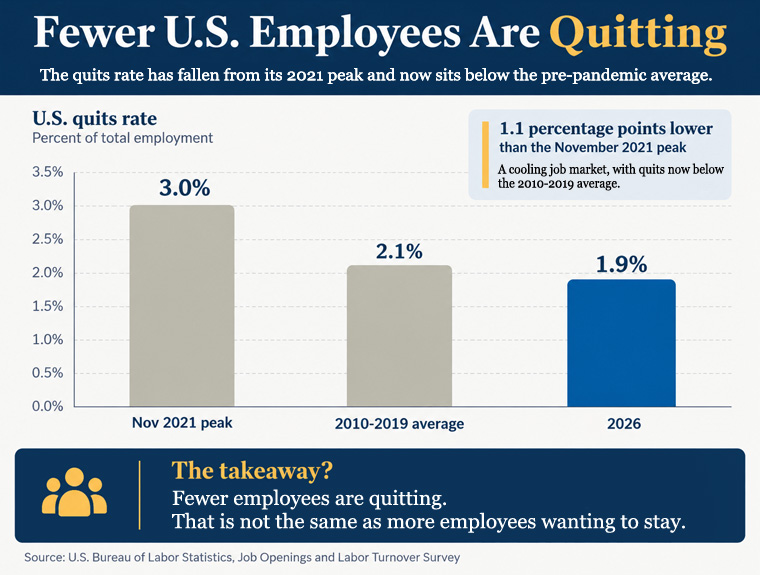
In July 2026, the Bureau of Labor Statistics reported 3.1 million quits nationally against 7.3 million job openings. Many employers have looked at their own improved turnover figures over the last two years and concluded that something they did is working. For most, that is not what happened.
Quits fall when there is less to move to. The employee who would have left in 2022 is still in the building, but nothing about their commitment has changed. They have simply run out of better options for the moment.
This is the more dangerous version of a retention problem, because it looks like a solved one. The employee who stays without wanting to is not engaged, does not recommend the job to anyone, and is the first out the door when the market turns. A tight labor market only postpones the consequences.
The useful question is not whether your turnover improved. It is whether the people who stayed would stay if they had somewhere to go.
Compensation is the most visible reason and the one most often cited. SHRM research has found that roughly half of employees who begin looking for another job do so over pay and benefits. You do not have to be the highest payer in your market, but you do have to be close enough that leaving is not obviously the better financial decision.
Recognition and appreciation run close behind, and they are less expensive to fix. SHRM found that nearly 80% of employees who left their jobs pointed to a lack of appreciation as a contributing factor. Employees rarely leave over one ignored contribution. They leave after a long accumulation of effort that nobody acknowledged.
Advancement matters more than most employers assume. An employee who cannot see what the next step looks like, or what it would take to get there, eventually concludes there isn't one. The absence of a visible path is read as the absence of a path.
The first ninety days carry more weight than any other period. Most employees decide early whether they made the right choice, and a structured onboarding process measurably improves the odds that the answer is yes. The highest-risk window for turnover is the first three years, which is precisely the period most recognition programs ignore.
And then there is the manager. People leave managers, not companies, is a worn phrase, but the underlying observation holds. The daily experience of a job is largely determined by one person, and that experience is where an employee decides whether to keep showing up.

Start before the hire. Screening for genuine alignment with the work and the culture, rather than qualifications alone, reduces early turnover more reliably than anything you can do after someone starts.
Then make the first ninety days deliberate. A new employee should know by the end of their first week what the organization is trying to do, how their work contributes, and who to ask when something is unclear. Recognizing the completion of onboarding, in some concrete form, marks the moment the choice was confirmed.
Benchmark your compensation on a schedule rather than in response to a resignation. By the time a good employee gives notice over pay, the conversation is already lost.
Make advancement visible. Tell people what the next role requires and what earns it. Promote from within whenever the choice is close.
Keep the conversations regular. Scheduled one-on-ones and stay interviews, which are conversations designed to find out what is keeping someone and what would change their mind, give you the information an exit interview delivers three months too late.
And recognize people consistently, not occasionally. This is the item on the list with the shortest distance between deciding to do it and having it done.
Recognition is not the whole answer to retention, and any vendor who tells you otherwise is selling. Recognition will not fix pay that is not competitive or a staffing model that does not work.
What it does do is address the largest reason employees give for leaving that is entirely within your control, at a cost far below the price of replacing them. It works when it is consistent, specific, and tied to things that actually happened. It fails when it is generic, automatic, or obviously an obligation.
If your organization runs on hourly employees working shifts, the retention problem has a different shape. Turnover rates in restaurants, retail, warehousing, distribution, manufacturing, and healthcare support roles run well above the national average, and the reasons are harder to see. Pay was competitive. Policies were reasonable. The person left anyway.
What changed was the daily experience of the work. Whether someone was welcomed on a first shift. Whether a schedule change was explained or simply posted. Whether effort was noticed. Whether a question got a straight answer. Those moments belong to supervisors, and most supervisors were promoted because they were good at the job, not because anyone trained them for the one they now have.
That is a solvable problem, but it is not solved at the policy level. It is solved on the floor.
Two books on keeping good hourly employees. One for the leaders who set the conditions, one for the supervisors who run the shift.
How recognition programs are built, what they cost, and what makes employees actually value them.
Milestone recognition from onboarding through retirement, including the early-tenure years when turnover risk is highest.
It depends entirely on your industry. A 90% annual retention rate is strong in professional services and unheard of in quick-service restaurants, where triple-digit annual turnover is common. Benchmark against your own industry and against your own history rather than against a general figure. The more useful measure is retention among your strong performers specifically, and retention within the first three years, where the risk concentrates.
Direct replacement costs typically run between 50% and 200% of the departing employee's annual salary, depending on the role and how specialized it is. That range covers recruiting, hiring, onboarding, and lost productivity during ramp-up. It does not include lost institutional knowledge, the productivity drag on coworkers covering the gap, or the effect on morale among the people who stay.
Rarely for one reason. Compensation is the most commonly cited, with roughly half of job seekers naming pay and benefits. Lack of appreciation is close behind and was a contributing factor for nearly 80% of departing employees in SHRM research. Limited advancement, poor communication, and the relationship with a direct supervisor account for most of the rest.
Yes, when it is done consistently. Recognition addresses the single largest controllable reason employees give for leaving, at a fraction of replacement cost. It is not a substitute for competitive pay, and occasional or generic recognition produces little. Consistent, specific recognition tied to real contributions produces measurable results.
Yes. Hourly and shift-based workforces turn over at substantially higher rates, and the causes are usually found in the daily experience of the work rather than in policy or pay. The relationship with an immediate supervisor carries more weight, and the first ninety days are more decisive.
Recognition is the most actionable item on this page, and it is what we do. Call 630-954-1287, Monday through Friday, 8:30 am to 5:00 pm CST, or get in touch and we will send an information packet with a sample award presentation packet and a gift-of-choice catalog employees use to select their own gift.
Founder and CEO, Select-Your-Gift | Employee Recognition Specialist
Greg Kern has spent more than twenty-five years helping companies build stronger workplace cultures through meaningful employee recognition. He founded Select-Your-Gift in 2001 and has worked alongside hundreds of employers in restaurants, warehouses, hospitals, manufacturing plants, and distribution centers. He is the author of the Frontline Retention Series. LinkedIn